NEWYou can now listen to Fox News articles!
The Supreme Court on Monday ruled that a Vermont state police sergeant is entitled to qualified immunity in a lawsuit brought by a protester who said she was injured when an officer used a wristlock to remove her from a sit-in at the state capitol.
In an unsigned per curiam opinion, the court reversed the 2nd U.S. Circuit Court of Appeals in Zorn v. Linton, holding that existing precedent did not clearly establish that Sgt. Jacob Zorn’s specific conduct violated the Constitution.
"The Second Circuit held that Zorn was not entitled to qualified immunity," read the majority ruling – with the three liberal justices dissenting – rejecting excess use of force arguments. "We reverse."
The justices said officers are generally shielded from civil liability unless prior case law put the unlawfulness of their actions "beyond debate."
JUDGE RULES FEDERAL AGENTS MUST LIMIT TEAR GAS AT PROTESTS NEAR PORTLAND ICE BUILDING
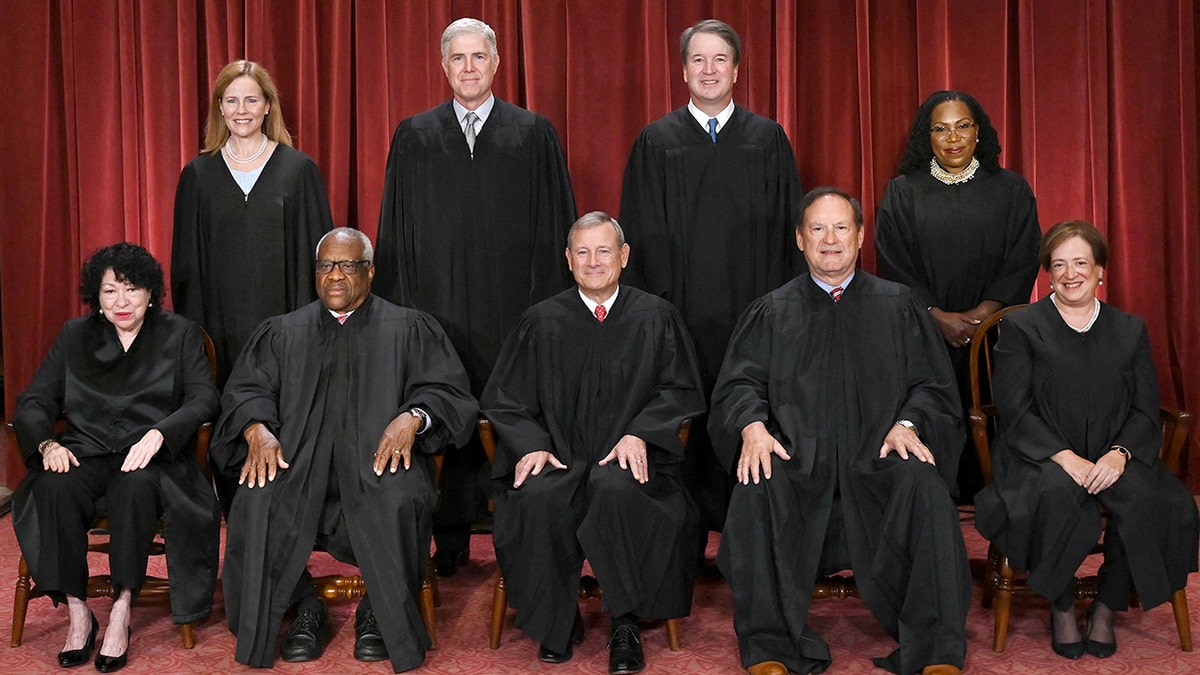
Just the three liberal justice dissented against the unsigned majority opinion. President Donald Trump brought three conservative justices to the Supreme Court in his first term, giving it a 6-3 conservative majority. (OLIVIER DOULIERY/AFP via Getty Images)
"Because the Second Circuit failed to identify a case where an officer taking similar actions in similar circumstances ‘was held to have violated’ the Constitution, Zorn was entitled to qualified immunity," the ruling concluded.
"We grant his petition for writ of certiorari and reverse the judgment of the Second Circuit."
The case arose from a 2015 sit-in by healthcare protesters at the Vermont capitol on Gov. Peter Shumlin's inauguration day. After the building closed, police moved to arrest demonstrators who refused to leave. According to the opinion, protester Shela Linton remained seated and linked arms with others.
Zorn warned her he would have to use force, then took her arm, placed it behind her back, applied pressure to her wrist and lifted her to her feet. Linton later sued, alleging physical and psychological injuries.
POSTAL SERVICE CAN'T BE SUED FOR INTENTIONALLY NOT DELIVERING MAIL, SUPREME COURT RULES IN 5-4 SPLIT
The Supreme Court said the 2nd Circuit relied too heavily on its earlier decision in Amnesty America v. West Hartford, finding that case did not clearly establish that "using a routine wristlock to move a resistant protester after warning her, without more, violates the Constitution."
On that basis, the justices concluded Zorn was entitled to qualified immunity and reversed the lower court.
Justice Sonia Sotomayor dissented, joined by Justices Elena Kagan and Ketanji Brown Jackson. She argued the court had improperly stepped in with the "extraordinary remedy of a summary reversal" and said a jury could find the officer used excessive force against a nonviolent protester engaged in passive resistance.

U.S. Supreme Court Justice Sonia Sotomayor wrote the dissent Monday in Zorn v Linton. (Jahi Chikwendiu/The Washington Post via Getty Images)
"A jury could find that Zorn violated Linton’s clearly established Fourth Amendment rights," Sotomayor wrote in the signed dissent.
CLICK HERE TO DOWNLOAD THE FOX NEWS APP
"The majority today gives officers license to inflict gratuitous pain on a nonviolent protestor even where there is no threat to officer safety or any other reason to do so," she concluded.
READ THE ORDER – APP USERS, CLICK HERE:
"That is plainly inconsistent with the Fourth Amendment’s fundamental guarantee that officers may only use 'the amount of force that is necessary' under the circumstances," Sotomayor wrote. "Therefore, I respectfully dissent."
Eric Mack is a writer for Fox News Digital covering breaking news.