NEWYou can now listen to Fox News articles!
Regulating advanced AI isn’t a game of checkers. It’s a game of chess.
Every move matters. You have to think several steps ahead. And if you focus only on the next play — or worse, react after the fact — you risk losing the long game.
Today, the United States finds itself at a turning point on AI, where real policy choices are being made. You can see it in the actions underway in both the states and Washington.
In recent months, leaders in both New York and California have passed landmark AI safety legislation. California’s SB 53 took effect on January 1, while New York’s RAISE Act was signed into law by Democrat Gov. Kathy Hochul in December and will take effect in 2027.
MIKE DAVIS: CONGRESS MUST STOP BIG TECH'S AI AMNESTY SCAM BEFORE IT'S TOO LATE
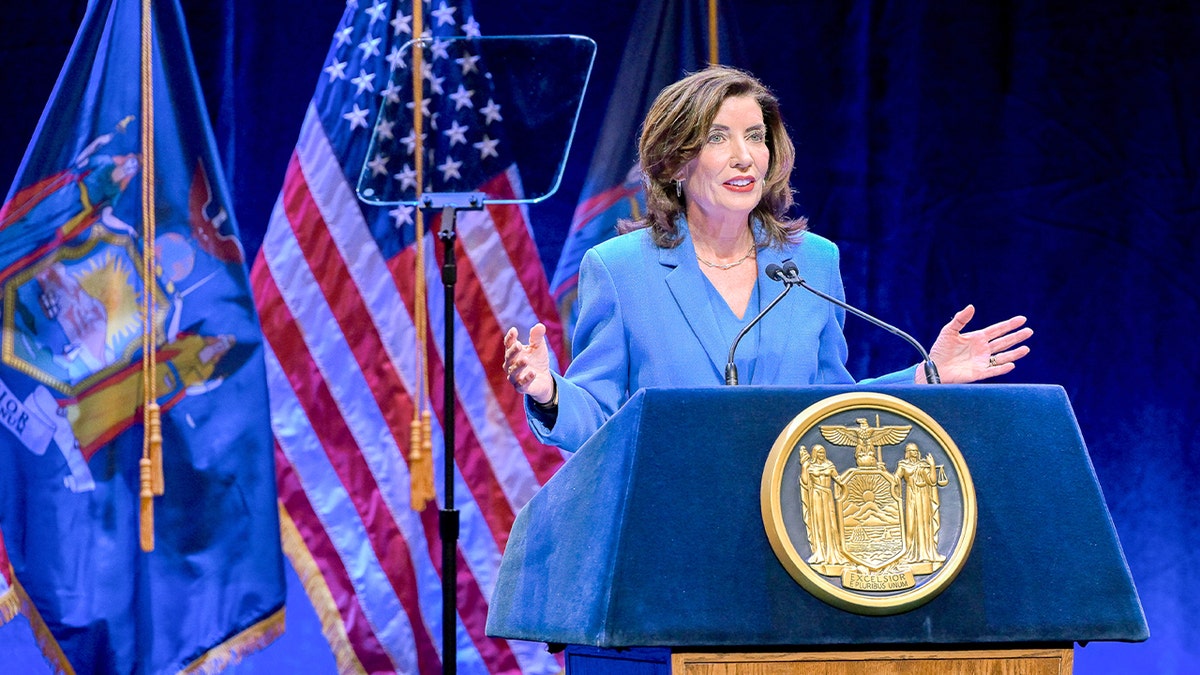
New York Gov. Kathy Hochul delivers her State of the State address at Hart Theatre at The Egg in Albany, New York, Jan. 13, 2026. (Heather Ainsworth/Bloomberg via Getty Images)
Both states are moving toward approaches that align state and federal law — recognizing that a fragmented, state-by-state patchwork isn’t sustainable. Given their size and economic impact, these moves create a clear path forward for federal action while positioning New York and California to lead the nation into the AI era.
There’s a word for this kind of alignment between state and federal action: harmonization. The federal government sets one clear national standard for the most powerful AI systems — the issues that affect national security and the country as a whole. States continue to focus on the issues closest to people’s daily lives: consumer protection, civil rights and how AI is used in schools, workplaces and public services. Each level of government plays to its strengths.
Think of it as one rulebook with two clear roles and one urgent mission: ensuring the United States maintains its competitive advantage in a technology central to national security and global economic leadership. Russian President Vladimir Putin has said bluntly that whoever leads in AI will lead the world. The United States can’t afford to drift — or to divide itself — at this critical moment.
STATE-LEVEL AI RULES SURVIVE — FOR NOW — AS SENATE SINKS MORATORIUM DESPITE WHITE HOUSE PRESSURE
That’s because AI leadership is increasingly an issue of national security — and national security requires prevention, not punishment after the fact.
When states act alone, they are often forced into a liability-only approach — holding companies accountable after harm has already occurred. Preventing the most serious risks requires access to the technical expertise and classified systems that only the federal government possesses.
That is why our North Star must remain clear: deploying frontier models safely and in a way that best positions the United States to maintain its innovation lead.
TRUMP ADMINISTRATION EYES SWEEPING FEDERAL POWER OVER AI, DRAFT ORDER SHOWS
That prevention-first approach already exists in practice. The Center for AI Standards and Innovation — created by the Biden administration and updated by the Trump administration — gives the federal government the ability to test and evaluate advanced AI systems before they are widely deployed. That kind of centralized testing is essential for managing risks that no single state or company can address on its own.
Without harmonization, AI companies would face a confusing patchwork of conflicting state requirements that slows innovation without improving public safety. With it, companies get clarity and consistency, the public gets stronger protections and states are given clear room to act where they add the most value.
Today, the United States finds itself at a turning point on AI, where real policy choices are being made. You can see it in the actions underway in both the states and Washington.
At the same time, states play a vital role, and the recent moves in New York and California show what that balance looks like in practice. By moving away from fragmented approaches and toward alignment, the two largest innovation economies in the country are helping create a de facto national standard that exists alongside, and not instead of, state action.
WHITE HOUSE OFFICIAL PRESSES ALLIES TO FREE AI FROM INNOVATION-KILLING REGULATIONS
This is what harmonization looks like in practice: Washington focuses on the highest-stakes safety issues, while states address kitchen-table ones. It is a third way forward — avoiding both unregulated acceleration and fragmented overreach.
Think about how we handle car safety. We don’t wait for accidents to happen and then rely solely on lawsuits to make cars safer. The federal government sets clear national safety standards. It requires rigorous testing. And it makes seatbelts, airbags, and braking systems mandatory — with strict rules for how well they must perform — before cars ever hit the road. Liability still matters, but prevention comes first, because the stakes are too high to get it wrong.
That balance isn’t new. It’s how the United States has governed aviation, food and drug safety, financial markets and telecommunications. In each case, the federal government set clear national standards for systems that power the entire country, while states continued to play a critical role closer to home. The result wasn’t less innovation or less growth. It was regulatory clarity, economic growth, and American leadership.
CHINA RACES AHEAD ON AI —TRUMP WARNS AMERICA CAN'T REGULATE ITSELF INTO DEFEAT
I saw this dynamic firsthand in 1996, when I was working in the White House just as the internet was beginning to reshape the economy.
Washington faced a choice that feels familiar today: apply old rules to a new technology, or agree on a new national framework built for what was coming next. Democrats and Republicans chose the latter.
CLICK HERE FOR MORE FOX NEWS OPINION
The result was the Telecommunications Act of 1996. It wasn’t perfect, but it got the big things right. It created clear national standards, gave innovators room to build and helped position the United States to lead the internet era that followed.
Think of it as one rulebook with two clear roles and one urgent mission: ensuring the United States maintains its competitive advantage in a technology central to national security and global economic leadership.
The lesson is straightforward. When America sets smart, national standards for emerging technologies, we don’t fall behind — we lead.
CLICK HERE TO DOWNLOAD THE FOX NEWS APP
The chessboard is set. If the United States focuses on prevention, harmonizes state and federal efforts, and keeps its eyes on that North Star, we can once again lead a defining technological era.
That’s how you win the long game: by playing chess, not checkers.
Chris Lehane is Chief Global Affairs Officer at OpenAI. Before joining OpenAI, he was Chief Strategy Officer and Operating Partner at Haun Ventures and previously led policy and communications at Airbnb from 2015 to 2021. He also co-founded a strategic consultancy, held various roles in the Clinton administration, and currently serves on Coinbase’s Board of Directors.