NEWYou can now listen to Fox News articles!
Two years ago, on April 18, 2024, New York Police Department officers arrested 108 students at Columbia University’s "Gaza Solidarity Encampment," triggering a wave of campus chaos that swept the nation and the world.
What followed was among the darkest chapters in American higher education: Jewish students assaulted and harassed, swastikas painted on buildings, American flags set ablaze, and more than 3,000 arrested for trespassing, vandalism and worse.
While it sparked widespread calls for campus reform — and strident efforts by the Trump administration to hold universities accountable — data suggests that the period left deep scars on university life, particularly an ongoing culture of fear and self-censorship.
FIRE’s 2026 college free speech survey shows that 91% of students now self-censor at least some of the time in conversations with classmates. Israel and Palestine are the most feared topics for open dissent, just ahead of abortion and transgender rights. At two prominent universities, 88% of students now pretend to be more progressive than they really are.
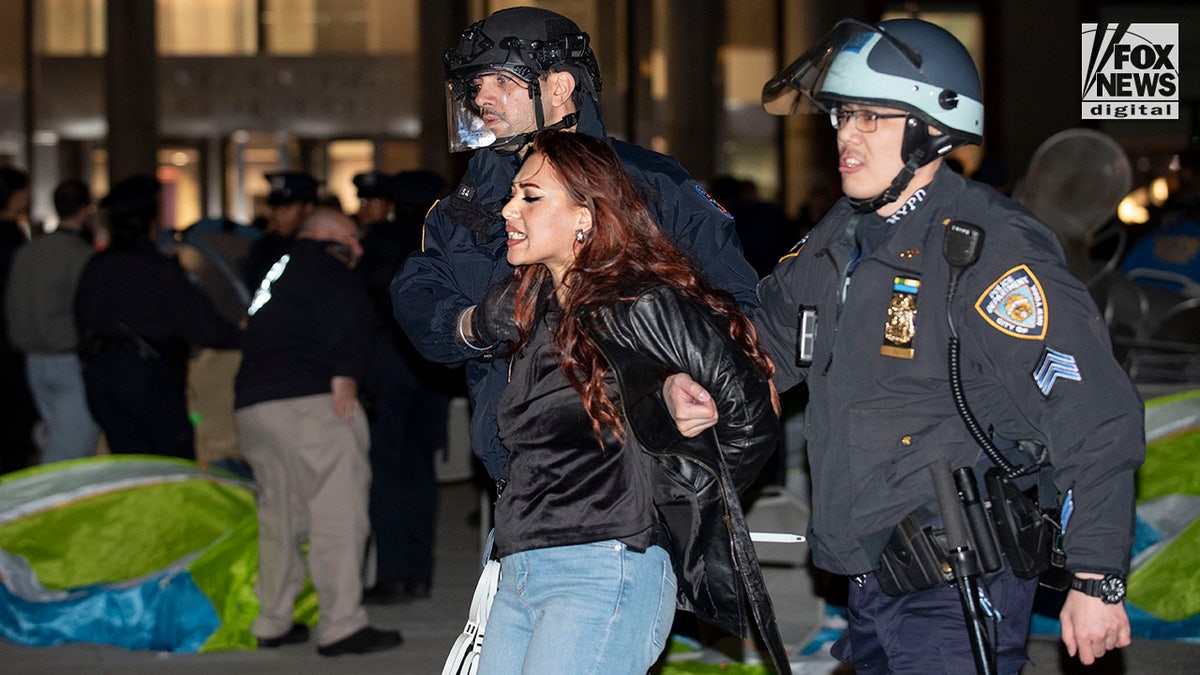
NYPD officers perform mass arrests of anti-Israel agitators as they stage a demonstration outside of NYU’s Stern School of Business in Manhattan, N.Y., on Monday, April 22, 2024. (Julia Bonavita/Fox News Digital)
Fear of social reprisal drives the trend, but it is no doubt reinforced by acts of violence against conservatives, including the assassination of TPUSA founder Charlie Kirk last year. Support for such acts continues to grow. The FIRE study shows that one in three students now believe violence can sometimes be justified to stop a speaker, a 70% increase since 2022.
The fear also extends to classrooms: roughly nine in 10 students self-censor in conversations with professors. There is little wonder why. In 1989, liberal professors outnumbered conservatives by roughly two to one. By the mid 2010s, the ratio was five to one. Today, across the humanities departments at Yale alone, Democrats outnumber Republicans 72-to-1. What few conservative faculty remain often hide their political views in order to keep their jobs.
As one University of Oklahoma student put it, "Why would I disagree with my professors [sic] strong and open political opinions when he is the one grading everything?"
COLUMBIA REVIEW FINDS JEWISH STUDENTS WERE CALLED 'MURDERERS,' BLASTED WITH ANTI-ISRAEL TIRADES
This self-censorship harms everyone, progressives not least of all. Shielding ideas from challenge renders fragile both the ideas and those who hold them.
The greatest victim is America itself. When young people spend four formative years practicing self-censorship, they do not shed that habit at graduation. They carry it into journalism, business, law, medicine, and their lives as citizens.
All around us today, we are seeing what happens when elites — at universities and beyond — use fear in an attempt to force ideological conformity onto the country. Trust vanishes, discourse hardens, and our people stop understanding each other. Society starts to fray.
While the post-Gaza campus climate is tragic for America, hope remains. Pushback from the Trump administration is yielding results. DEI programs are being shuttered and many universities have adopted institutional neutrality policies that restrain them from taking positions on political and social topics.
CLICK HERE FOR MORE FOX NEWS OPINION
But universities have more to do. Much more. Their goal should be to recover the vision of Mortimer Adler, who helped pioneer academic freedom standards at the University of Chicago. He believed that the purpose of higher education was "to develop free human beings who know how to use their minds and are able to think for themselves."
The fear also extends to classrooms: roughly nine in 10 students self-censor in conversations with professors.
This requires restoring true intellectual diversity among the faculty. Universities would also be wise to get a pulse on what students really believe, such as through anonymous surveys, and then publicly commit to defending all viewpoints. Alumni and donors can play a role, too, by tying support to free inquiry metrics.
CLICK HERE TO DOWNLOAD THE FOX NEWS APP
Above all, we need the higher education system to understand its role in the formation of virtue, particularly that greatest of civic virtues — courage. Without it, we cannot speak or defend truth, maintain integrity when unpopular, or foster the habits of mind required for self-governance.
The Gaza protests proved that fear is contagious on campuses. But courage can be, too. Our universities must decide which they intend to teach.
Rob Noel is a speechwriter who serves as president of Washington Writers Network.
CLICK HERE TO READ MORE FROM WILLIAM BENNETT
William J. Bennett joined FNC as a contributor in 2017.
The former Secretary of Education under President Ronald Reagan and the nation's first Drug Czar under President George H.W. Bush, Bennett is one of America's most recognized voices on cultural, political and educational issues. He also served as a professor at Boston University, the University of Texas, and Harvard University.
A native of Brooklyn in New York City, Bennett studied philosophy at Williams College (B.A.) and the University of Texas (Ph.D.) and earned a law degree (J.D.) from Harvard.
In addition to his role at FNC, Bennett currently serves as chairman of Resilience Learning and is the Founding Provost of Jefferson Classical Academies. He has written or co-authored more than 25 books, including the Book of Virtues.